
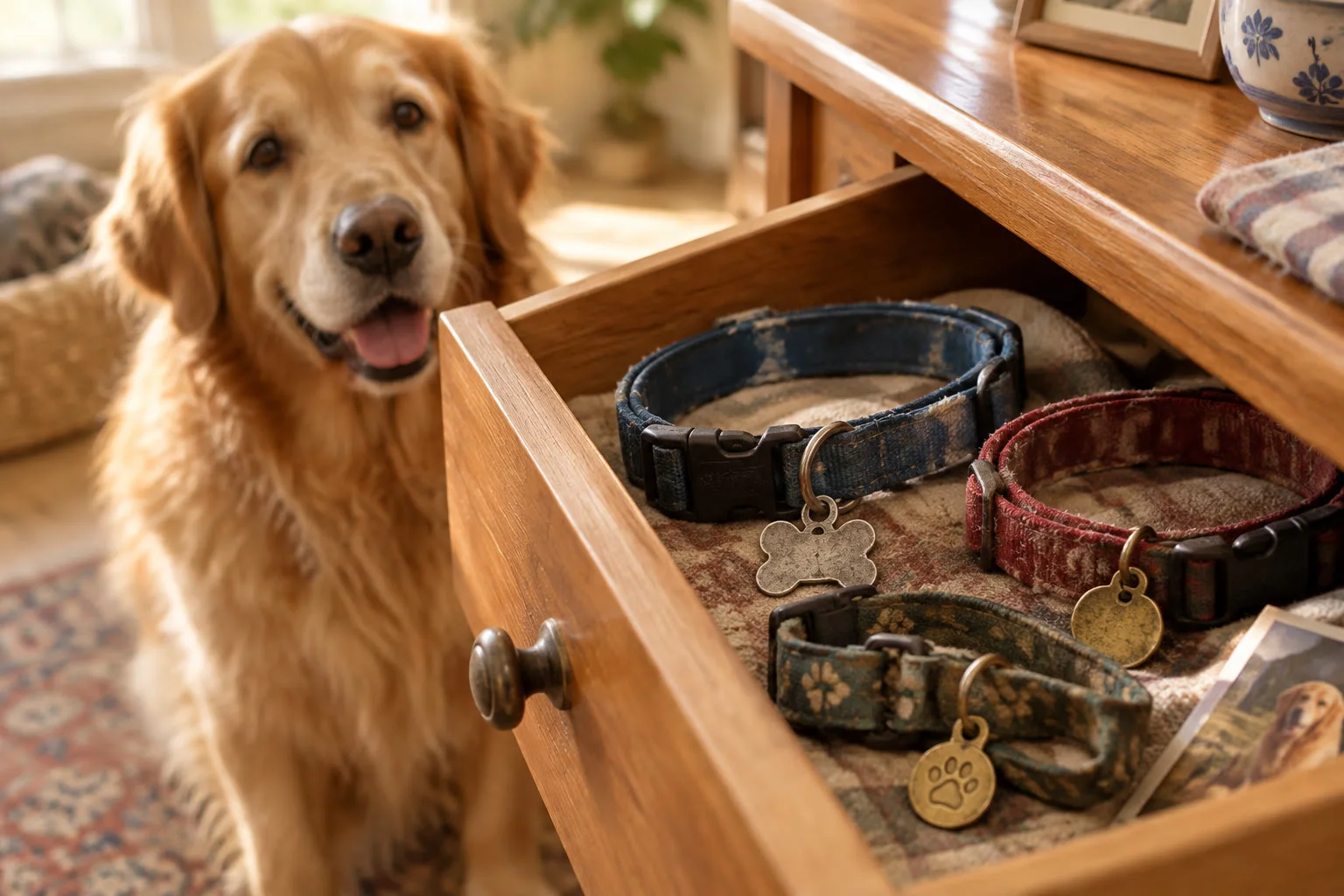
Somewhere in almost every golden home there is a drawer. In it lives the tiny first collar, the rabies tag from a vet who has since retired, a leash with the handle chewed by a teething land shark, and a jingle of name tags from every era. Nobody planned the collection. Nobody can throw any of it away.
How the drawer happens
It starts innocently. The puppy outgrows the first collar in what feels like eleven days, and you set it aside because it seems wrong to bin something that small and that loved. Then comes the holiday collar. The replacement tag with the new phone number. The bandana from the birthday photo. One day you open the drawer and realize you have been curating a museum.
Guests who find the drawer always go quiet for a moment. Every item is small enough to lose and somehow impossible to throw away, and everyone who has loved a dog recognizes the feeling immediately. It is the most universal collection in the world, assembled one tiny buckle at a time.
That is not clutter. That is a timeline you can hold in your hand.
The outgrown harness goes in beside the collars, and eventually the first winter coat, the one that made the puppy look like a tiny attending physician. Each piece marks a size the dog will never be again, which is exactly why it stays.
The drawer has cousins
Once you start keeping, other small archives suggest themselves. The vet folder with the vaccine records and the weight curve printouts. The toy basket's bottom layer, where the first squeaky lives under every successor. The folder on your phone marked with his name that somehow holds four thousand photos.
None of it needs organizing to count. A keepsake you can find in thirty seconds is nice; a keepsake that exists at all is the actual point.
What the small things remember
Objects keep memories the way photos cannot. The puppy collar still smells faintly like the breeder's house. The chewed leash handle is Exhibit A in the story you tell about the teething months. The jingle of a particular tag can stop you mid-afternoon, because that exact sound used to announce breakfast.
The collars themselves chart the growth better than any scale: the tiny buckle of the eight-week stringbean, the medium of the teenage loper, the broad strap of the adult in his prime. Held end to end they are a growth chart you can buckle.
Some owners date the inside of each collar with a marker before it goes into the drawer: the months it served, the era it covered. It feels excessive in the moment and prescient later, because memory blurs the sequence surprisingly fast, and the little inked dates put every era back in its place.
The drawer also makes a surprisingly good conversation with the future. Tuck in a note to whoever opens it next, even if that is just older you: what this collar's era was like, what the dog was into, what the jingle meant in that house at that time. Objects keep the shape of the memory; the note keeps the voice.
The drawer collects other residents over the years: the tag from the microchip registration, the ribbon from a fun-run you walked together, the hotel key card from the first road trip where the dog was the best-behaved member of the party.
There is real comfort in knowing the drawer exists. In a world of cloud backups and digital everything, it is the analog archive: no password, no subscription, just a ribbon of nylon that meant the world to someone four-legged.
Give the collection a little order
You do not need to organize it into a display, but a few small habits make it sweeter. Drop a dated note in with each new addition. Keep tags on a single ring so the jingle stays intact. If you are the crafty sort, a shadow box with the first collar, first tag, and a puppy photo makes a genuinely touching piece for the hallway.
The drawer pairs naturally with keeping a puppy growth journal, which remembers the stories, and paw prints in the first snow, which is about the marks worth keeping before they melt.
The drawer is allowed to grow
As the years add up, so will the drawer, and that is exactly right. It is proof of a life thoroughly lived and thoroughly loved, one small buckle at a time. Some of the best family archives fit in the palm of your hand.
Start yours tonight if you have not. One drawer, one collar, one dated note. Future you, rummaging through it on some quiet afternoon, will be so glad you did.
And when the drawer eventually holds the last collar, the one from the gray-muzzle years, it will still be doing its original job: keeping small things safe so the big thing is never lost.
Keep reading
More memory keeping: Keeping a Puppy Growth Journal and Paw Prints in the First Snow.
Made with a little extra love for golden retrievers.