
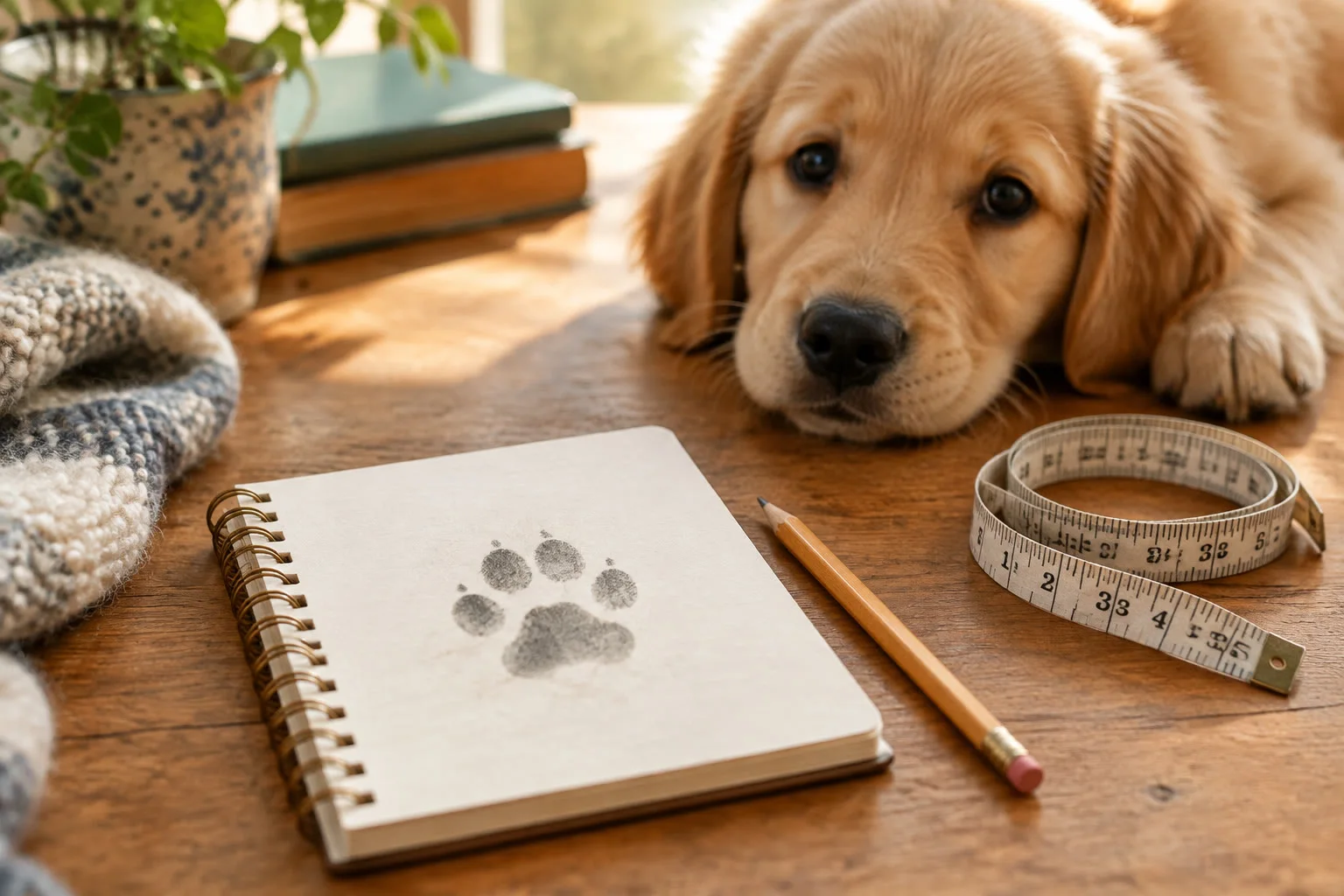
Nobody warns you how fast the details go. The exact weight at nine weeks. The first night he slept through. The day the grown-up bark arrived and startled you both. A puppy growth journal catches all of it in ten minutes a week, and one day it will be the funniest, sweetest book on your shelf.
What to write down
Keep it simple enough to actually do: the date, the weight, and three lines about the week. What he learned. What he destroyed. What made you laugh out loud. That last category will do most of the work when you reread it in five years, because golden puppies are dependable comedians.
Add the numbers you will not find later: the name of the trainer, the brand of the first kibble, the vet's first weight guess for the adult dog, the exact day the last baby tooth vanished. Trivia now, treasure later.
Measurements are surprisingly precious. The weekly weigh-in on the bathroom scale, the paw traced in the corner of a page, the collar notch marked as it moves. Puppies grow in spurts you swear happened overnight, and the journal is the only proof you will have that the tiny phase existed at all.
For the weeks when your mind goes blank, keep three prompts taped inside the cover: the best moment, the funniest moment, and the thing he is finally starting to understand. There is always an answer to all three.
When you miss a week
You will miss a week. Probably the same week the puppy eats a baseboard. The journal forgives: write three lines whenever you pick it back up and never apologize to a notebook. A journal with gaps is a record. A journal abandoned for perfect attendance is nothing.
Some families keep a running note on a phone for the chaotic weeks, one line per day at most, and copy the highlights into the real book on Sunday. The two-tier system keeps the ritual alive through teething season, which is when the best material happens anyway.
Make it a ritual, not a chore
Attach the writing to something that already happens. Sunday morning coffee. The evening after the training class. Keep the notebook in the kitchen where the treats live, not in a desk drawer you never open. The bar should be low enough that even an exhausting week earns three lines.
Let the whole household contribute. Kids' spellings, a partner's one-liner, a grandparent's note after a visit. A golden puppy is a family event, and the journal reads best when it sounds like one.
Some families add a photo corner to the notebook, one small print per month glued beside the entry. It makes the writing sessions feel like scrapbooking, and it gives the page-proofers of the household a reason to keep up.
Read it aloud occasionally. Sunday mornings with coffee and a puppy asleep on your feet, read a page from two months back. The entries that felt ordinary when written turn out to be the funniest, and the dog gives no sign of remembering the baseboard incident at all.
The entries you will not expect
Write down the hard weeks too, briefly. The biting phase. The accident on the good rug. The night you questioned every decision. They are part of the story, and reading them later, beside the photo of the calm adult dog asleep at your feet, is its own quiet triumph.
Record the firsts as they happen: first swim, first snow, first time off leash in a safe field, first night sleeping straight through. You think you will remember the dates. You will not, and the journal will.
Years from now, the strangest entries will be the ordinary ones. What the walk looked like. Which toy was in favor. The price of a bag of kibble. Daily life is the first thing memory lets go of, and it is exactly what the journal keeps safe.
Pair the journal with the first year in twelve photos and you have the full record, words and pictures. When the teething treasures start accumulating, the collar drawer covers what to do with the little physical keepsakes.
One day it is the best book you own
The payoff arrives years later, usually on a random evening when the notebook falls off the shelf. You will sit down on the floor to flip through it, and the dog, now dignified and graying, will come lie down beside you, exactly as he did when his whole body fit in the margin of one page.
That is the moment every skipped week was worth forgiving. The puppy phase is four months long and the journal makes it last the rest of your life.
Start tonight, whatever week you are in. Even if the puppy is already five months old, even if the dog is five years old. The best week to begin was the first one; the second best is this one. Three lines, tonight, about what made you laugh.
Keep reading
More memory keeping: The First Year in Twelve Photos and The Collar Drawer.
Made with a little extra love for golden retrievers.