
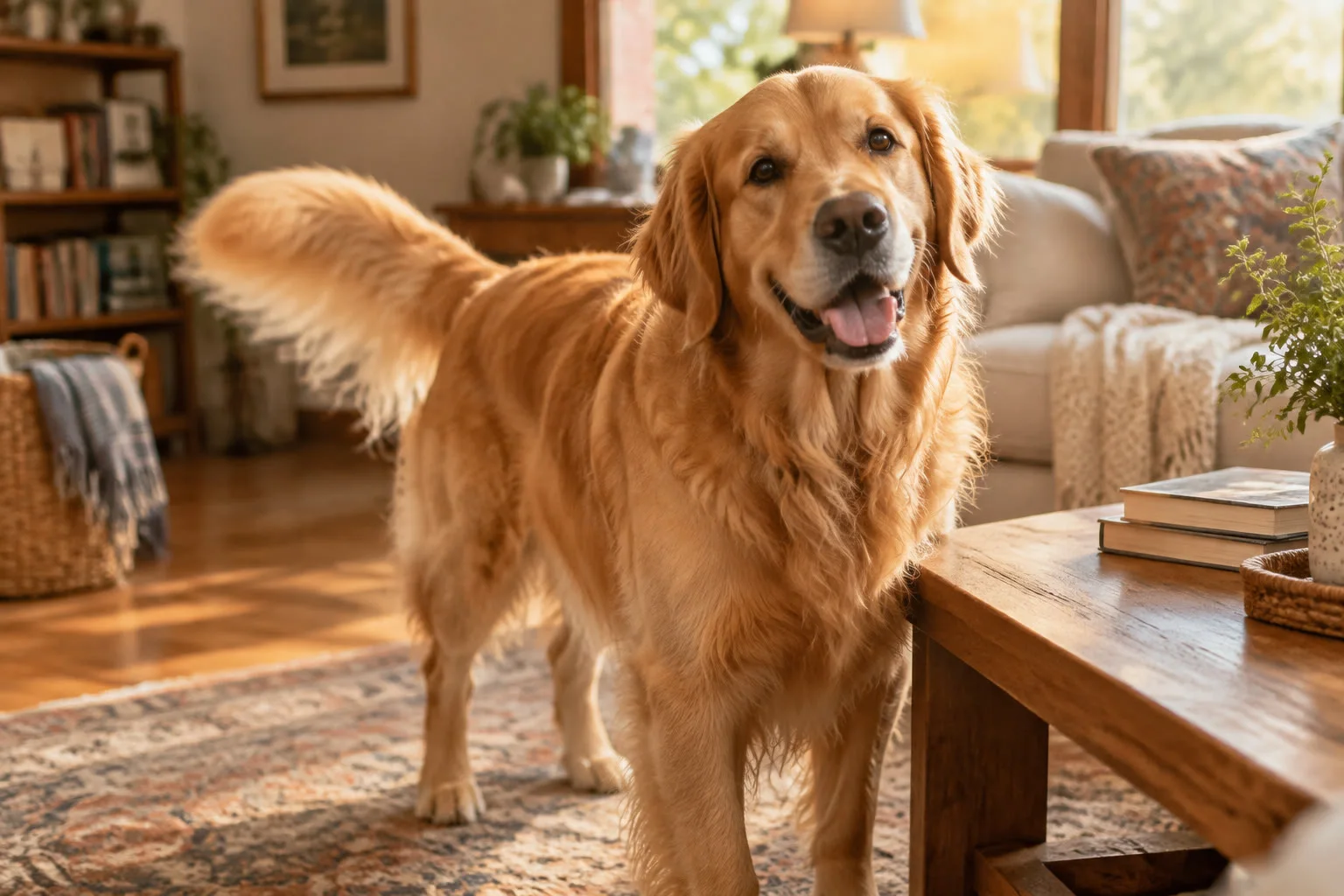
Every golden household learns the rule eventually: nothing fragile lives at tail height. That magnificent plume is not just a tail. It is a mood indicator, a metronome, a dusting service, and occasionally a small wrecking crew, all powered by pure feeling.
The honest barometer
A golden's tail tells the truth all day long. The helicopter spin at the door. The slow, thoughtful sway when you say their name from across the room. The low, uncertain wag when the suitcase comes out. Long before you read a face or a posture, the tail has already filed its report.
Learning to read it is one of the quiet pleasures of the breed. You start to notice the difference between the polite wag for guests and the full-body wag reserved for their favorite person, and it is impossible not to feel a little honored by the distinction.
The wag even starts early. Say the word walk in the kitchen and the thumping begins before the leash moves, sometimes before you have finished the word. Goldens do not wait for confirmation of good news. They celebrate the rumor.
There are dialects worth learning. The high, fast wag is pure excitement. The slow, wide sweep at half-mast is contentment, the wag of a dog being petted by a favorite person. The low, careful wag with the head slightly turned is uncertainty, a question more than a statement. Read the whole dog, not just the metronome, because a wag is always honest but it is not always happy.
Physics of happiness
The coffee table was simply built in the strike zone. At the height of full joy, a golden tail swings with real enthusiasm, and anything in its path, mugs, remotes, a carefully stacked pile of mail, becomes part of the celebration. Seasoned golden people rearrange their homes around this fact without even being asked.
There is a bright side. A tail that strong is a tail that healthy, attached to a dog that happy. The swept-off magazine is the tax on living with an animal who cannot contain good news.
Puppies grow into the equipment, by the way. A young golden's tail seems to operate on its own schedule, swinging at full power while the rest of the dog is still deciding what happened. The aim improves with age. The enthusiasm does not.
When the wag needs care
One honest footnote: a tail that powerful can injure itself. Happy tail syndrome is the unglamorous name vets give the sore, split tip that comes from whacking walls and cabinets with real force, and it is common in exactly the dogs this article celebrates. If you ever notice blood spatter at tail height or a drooping, tender tail, that is a vet visit, not a wait-and-see.
The prevention is the same as the decor advice: clear the strike zone. A padded corner near the door and a coffee table with nothing sharp-edged at wag height protect both the stemware and the stem.
Design for the wag
A few small changes keep the peace: lift the breakables, choose a sturdy bowl for table water glasses, and give the greeting zones some clearance near doors and hallways where the biggest wags happen. Think of it less as dog-proofing and more as accommodating joy.
Long-time golden households stop noticing the adjustments. The candles migrate upward. The hallway bench loses its decorative basket. The house quietly reorganizes itself around the orbit of one very happy tail, and nobody can remember when it happened.
Visitors eventually assume you decorated this way on purpose, and in a sense you did. The wag was there first. Everything else just learned to orbit it.
It helps to think in tail radius. The danger zone is roughly the length of one happy golden from hips to tip, plus a margin for enthusiasm. Anything precious that lives inside that circle will eventually be baptized by joy, so the circle gets the sturdy furniture and the unbreakable bowls.
If the wag is your favorite household weather report, the sleepy opposite is the art of the golden nap, and the indoor energy behind some of those sweeps can be channeled with rainy day games.
The wag you hear before you see
Ask anyone who lives with a golden: you can identify the mood of the house from another room. The tail thumping against the cabinet means someone opened the treat drawer. The rhythmic swish against the floor means a nap is winding down happily. The sudden silence means the cat walked in.
Visitors learn the soundtrack too. Regulars stop flinching at the cabinet thump, and new guests get the translation: that sound means you have been approved.
It is an odd little soundtrack, and you stop noticing it, right up until a quiet house without a dog reminds you what was missing.
Keep reading
More everyday gold: The Art of the Golden Nap and Rainy Day Games for a Restless Golden.
Made with a little extra love for golden retrievers.