
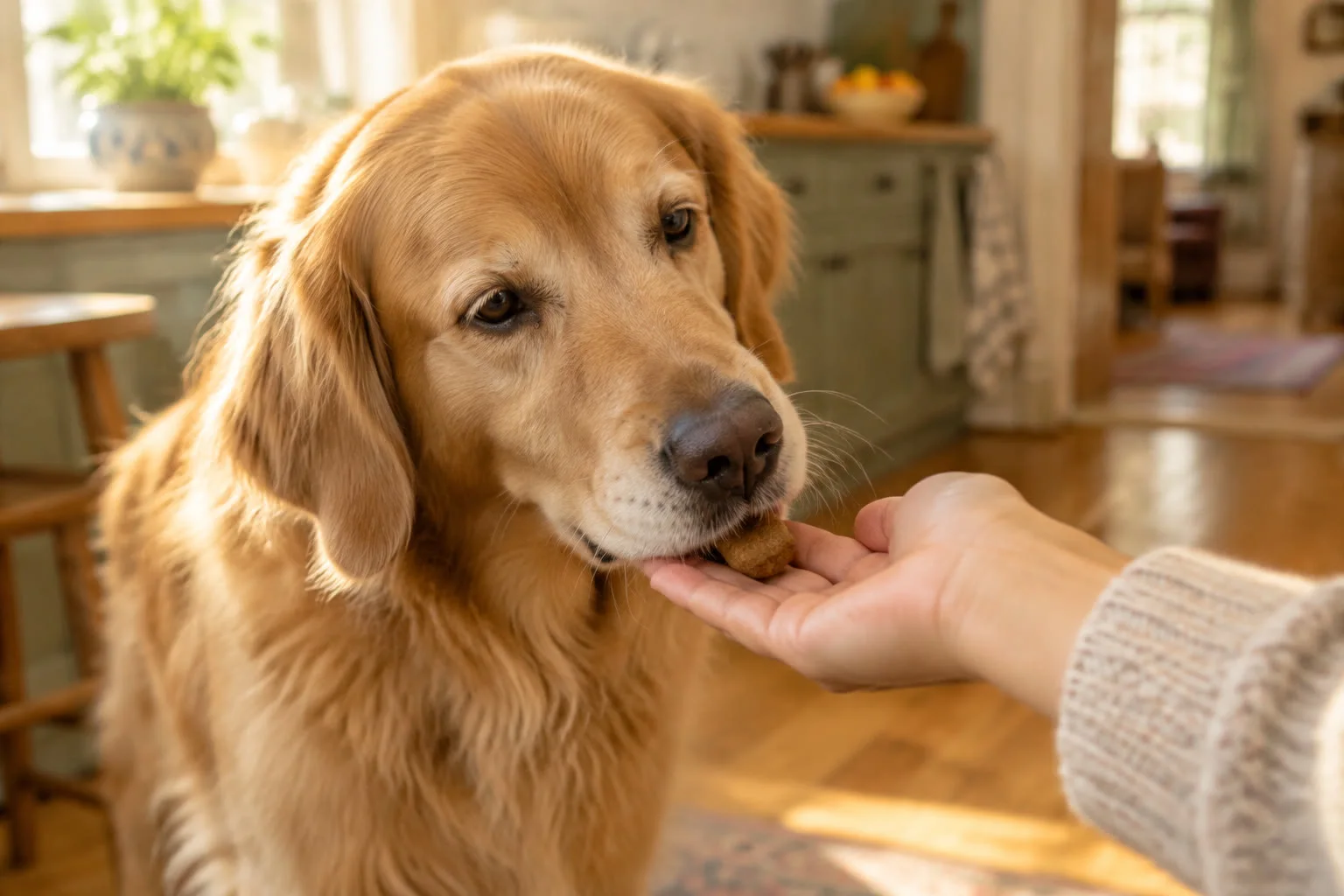
Golden retrievers are famous for soft mouths, but excitement is excitement, and an untrained treat grab can still leave your fingers feeling like they lost an argument. The gentle take is one of the first and most useful manners you can teach, and goldens, being natural-born carriers, learn it beautifully.
Start with the closed fist
Hold a treat in your closed fist and let your dog investigate. There will be sniffing, licking, maybe a thoughtful paw. Wait. The moment the mouth backs off, even for a second, say your marker word and open your hand. The treat is the reward for softness, and the lesson lands fast: pushiness closes the hand, gentleness opens it.
Practice for a few minutes at a time, a couple of sessions a day. Golden puppies pick this up within days; older dogs within a week or two. The principle never changes, only the speed.
The waiting is the teaching, so resist helping. No pulling the hand away and no lectures. The dog does the experimenting, the hand does the answering, and the rule stays beautifully simple: soft gets the treat, rough gets nothing at all.
Move to the open palm
Once the fist game is solid, offer the treat on a flat open palm, the way you would feed a horse. This is a safe position for fingers and it teaches the dog to take food with lips and tongue rather than front teeth. If the grab is too rough, the hand simply closes or turns away, and the treat vanishes. The treat returning only for gentle mouths is the whole curriculum.
Add your cue, something like easy or gentle, said in a calm tone right as the soft take happens. Over time the word alone will slow the mouth down, which is a genuinely useful bit of remote control at birthday parties and picnic tables.
Spread the skill around
Practice with different people, different treats, and different levels of excitement, because a dog who is gentle at the kitchen counter may forget everything at the park. Kids should practice only with an adult running the session. Consistency across the whole household is what turns a trick into a habit.
Expect the skill to wobble when excitement spikes, right when you need it most. That is normal, not failure. Lower the excitement, rebuild the win with something easy, and end on a success. The gentle mouth always comes back, and each rebuild makes it sturdier.
Keep a few treats in a jar by the door during the learning weeks, so every visitor becomes a practice rep. Guests love being part of the training, and the dog learns that new hands follow the same gentle rules as familiar ones.
The gentle take builds directly on the soft mouth described in the soft-mouth parade, and it is the perfect warm-up for the patience required in the reliable recall.
Why it matters beyond treats
A dog who understands gentle understands something bigger: that calm behavior is what makes good things happen. That idea bleeds into greetings, leashes, doorways, and the vet's scale. It is a small lesson with an outsized return.
Watch for the day it shows up uninvited: the toddler's sticky hand offering a crust, the dropped slice of pizza, the neighbor's well-meaning cookie. The dog who takes each one softly is showing off months of two-minute sessions, all paid back in one polite moment.
The progression is simple. Fist closed until the teeth back off, open palm for easy wins, then treats on the back of the hand, then a treat held between fingertips like something precious. Each stage ends with the golden looking faintly smug, and he has earned it.
Keep sessions to a couple of minutes and always end on success. Goldens train best in short, happy bursts, and a dog who finishes wanting more brings his best manners to the next round. Two minutes twice a day beats twenty minutes once a week, every time.
Watch for the moment it clicks: the approach slows on its own, the whiskers brush your palm before the lips ever touch the treat, and the dog checks your face as if to confirm the performance. That is not just training. That is a golden showing off his self-control, and he knows exactly how good he is being.
Spread the practice around once the basics stick: different rooms, different hands, different treats, then the outdoors with its smells competing for attention. Kids make excellent trainers for this one under supervision, because a golden who learns to take gently from a small, wobbly hand has truly learned it. Everyone the dog meets becomes either a rehearsal or an audience, and both move the training forward.
Around here the final exam is a small child holding a cracker in an open palm, and the golden collecting it like fine glassware. That is the goal, and it is absolutely within reach for any dog willing to trade enthusiasm for technique.
Keep reading
More good manners: The Soft-Mouth Parade and The Reliable Recall, One Whistle at a Time.
Made with a little extra love for golden retrievers.